The Workshop Handout Before the Photocopier
A workshop handout works best when it grows from learners’ notes into a reusable aid, with each format chosen for the task rather than habit.
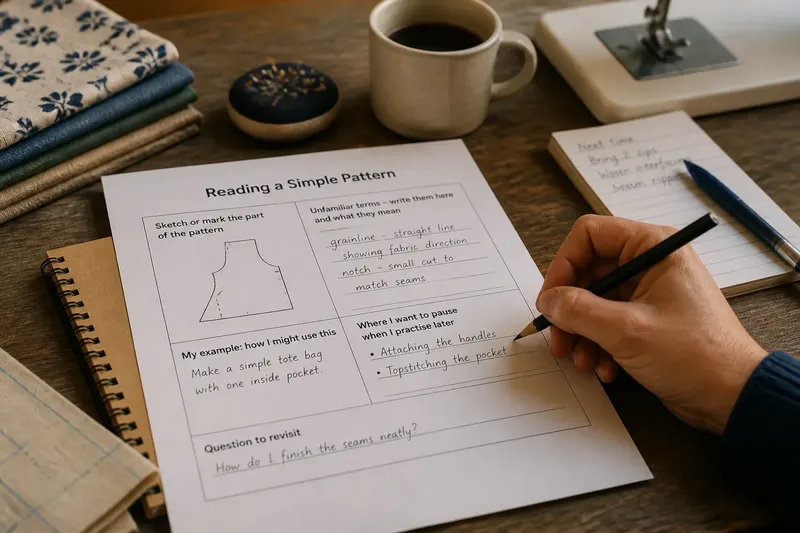
A workshop handout should begin with the learner’s next action, not with a blank page beside the photocopier. In an adult class, written materials may start as personal notes, become a shared sheet and later settle into a reusable aid—or remain notes because that suits the work. Choosing the form in that order keeps paper, screens and instructor effort in service of learning.
What should the handout help someone do?
Before writing, name the point at which a learner is likely to need support. Is it remembering a sequence after the tutor has moved on, recording a personal decision, checking a new term, or taking a task home? A sheet that tries to do all four may become a small filing cabinet with no filing system.
Choose one main job and state it in plain language. For example: “Use this page to record the steps you want to practise after class.” That sentence gives you a test for every possible item. If a definition, diagram or note-taking box does not serve that job, leave it out or make it optional.
Also consider what learners already bring. In a community cooking session, some may want a recipe to annotate; in a local history workshop, the useful record may be a question beside a name or place. The subject matters, but so does the moment of use. A learner who needs to write while listening should not have to turn a page every time the tutor changes topic.
How can personal notes become a shared resource?
Begin with a modest structure rather than polished prose. A useful first draft might have a title, a few topic labels, open space for notes and one prompt that tells learners what to record. Keep the wording close to the language used in class, then replace any term that depends on the tutor being present to explain it.
Read the draft as a learner who has missed one sentence. Can they tell where to write, what a symbol means and which parts are their own observations? Labels such as “My example” or “Question to revisit” make the page easier to use than several empty boxes whose purpose is left to guesswork.
Say you are preparing a community sewing session on reading a simple pattern. You draft a single page with a small sketch area, a space for unfamiliar terms and a prompt to note where the learner wants to pause during later practice. The expected observable result is a page that can hold each learner’s own marks while still reminding them what to pay attention to; it need not become a complete pattern manual.
Do not assume that every useful note belongs in the shared version. Private reminders, personal examples and rough questions can be valuable precisely because they belong to the individual. Ask whether the class needs a common record, or whether learners need a frame that makes their own record easier to create.
When is a printed sheet worth making?
Print when a physical page improves access or use: learners need room to write, the class works away from devices, or the material must sit beside a practical task. A sheet can be passed around, marked up and taken home without asking anyone to manage a file. It can also be awkward to revise, carry or replace, so print only what has a clear job.
Before copying, check the page at actual print size. Use headings that remain distinct in black and white, avoid relying on colour alone, and leave enough space for handwriting. A tiny font is not a clever way to persuade an adult learner that three pages are really one. Use readable type and remove material that does not support the stated task.
Consider whether people need an individual copy or whether one shared reference is enough. A tutor may keep a large-print version available, while learners who prefer to write can use a separate notes page. Where a learner may need an accessible format, ask what works for them rather than treating one layout as universal.
Give the sheet a visible title and a simple version date or class label if it is likely to be reused. That small marker helps distinguish current materials from an older page in a folder. If the content changes often, a printed master for tutor use may be more sensible than distributing copies that soon contradict the class.
Could another format serve the same purpose?
A paper handout is one option, not the destination. A shared digital document can be useful when learners need to revisit links or enlarge text. A whiteboard record may suit a brief class discussion, while a set of prompt cards can keep a reference close to a workbench. The format should follow the task, not the convenience of the person who prepared it.
Think of the handout like a kitchen utensil: a wooden spoon is useful for some jobs, but it is not improved by being used as a ruler. Similarly, a worksheet is not automatically the right container for a conversation, a demonstration or a personal reflection. Sometimes the written aid should be a short prompt, with the rest of the learning happening in speech or practice.
- Personal notes: useful when learners need to connect the class with their own questions or examples.
- Printed sheet: useful when writing space, quick access or working away from devices matters.
- Digital document: useful when material needs links, editable text or a version learners can revisit.
- Shared display: useful for a temporary record that the group can discuss and then leave behind.
- Prompt card: useful when a short reminder must stay near the activity without covering the table.
These forms can coexist. A learner might use a paper page for notes and receive a digital copy of a reference list afterwards. Make the relationship clear: say which item is the learner’s working record and which is simply an aid to consult.
How should you shape the page for real use?
Put the most useful information where the learner will look first. Use a descriptive title, short sections and consistent labels. If a sequence matters, show the order plainly; if learners are comparing options, use a small table only when it remains legible and leaves room for their own comments.
Keep instructions separate from content. “Write one question you want to return to” is an instruction; a list of terms is reference material. Mixing them can make a sheet feel busier than it is. A short line explaining what to do with a blank space can be more helpful than adding another paragraph of background.
Use diagrams where they clarify a relationship or location, not as decoration. Add labels that can be understood without colour, and avoid shrinking a useful drawing to make room for more prose. If the aid needs a long explanation to be usable, the design may be asking the page to do too much.
For a class with varied reading confidence, favour plain sentences, familiar vocabulary and generous white space. Define a necessary specialist term at the point where it first appears. Offer a way to ask for clarification without making the learner disclose why the wording is difficult.
What should you check before sharing it?
Read the material aloud and follow its instructions in order. That catches sentences that look tidy but become unclear when spoken, as well as prompts that ask for information the page has not made room to record. If possible, ask a colleague to use it without a verbal explanation. Their questions reveal where the page relies on knowledge that only the tutor has.
Check the practical details too: page orientation, margins, labels, links and any image credits or permissions relevant to your material. If you use a digital file, make sure the text remains readable on a phone as well as a larger screen, if learners may use either. Where the right answer depends on a label, manufacturer instructions or local rules, follow the relevant source rather than improvising.
Then decide what is essential and what can be removed. A handout does not need to preserve every sentence spoken in class. It needs to help with the chosen task, and leave space for the learner’s own thinking.
What do learners ask about workshop handouts?
Should every learner receive the same handout?
A shared core can make the class easier to follow, but people may benefit from different ways to use it. Offer alternatives such as a blank notes page, a large-print copy or a digital version where practical, and explain that these are options rather than remedial versions.
How much text belongs on one page?
Use as much as the task needs and no more than the page can carry clearly. If learners must read while listening or working, shorten the prose and make the action easy to spot; if the sheet is a reference for later, fuller explanation may be useful.
Should a handout include the tutor’s full explanation?
Usually not. Record the terms, prompts and reminders learners need to revisit, while leaving spoken explanation and discussion to the class. A transcript may be appropriate when learners need one, but it should be designed for that purpose rather than assembled by default.
When should an old handout be revised?
Revise it when learners repeatedly ask what a label means, when an activity changes, or when the sheet no longer matches what happens in class. Keep a note of the change so the next copy is distinguishable from the one already in circulation.
How can the handout remain useful after class?
Tell learners what to do with it next. They might keep it beside their own notes, mark a question for the next session or use a short prompt to revisit the subject at home. Avoid prescribing a complicated routine when the material only needs occasional reference.
After the class, look at the page with a practical question: did it help learners record or retrieve what they needed? Comments, missing notes and frequently confused labels are useful clues, not a verdict on the format. Change one feature at a time where possible, so you can see what the revision is meant to improve.
Keep the editable source file and a clean copy for reuse, but do not let the master version become detached from the class it serves. A workshop handout earns its place when someone can use it without the tutor standing beside them. That may be a marked-up scrap, a carefully laid-out page or a file on a phone; the photocopier is only one stop along the way.